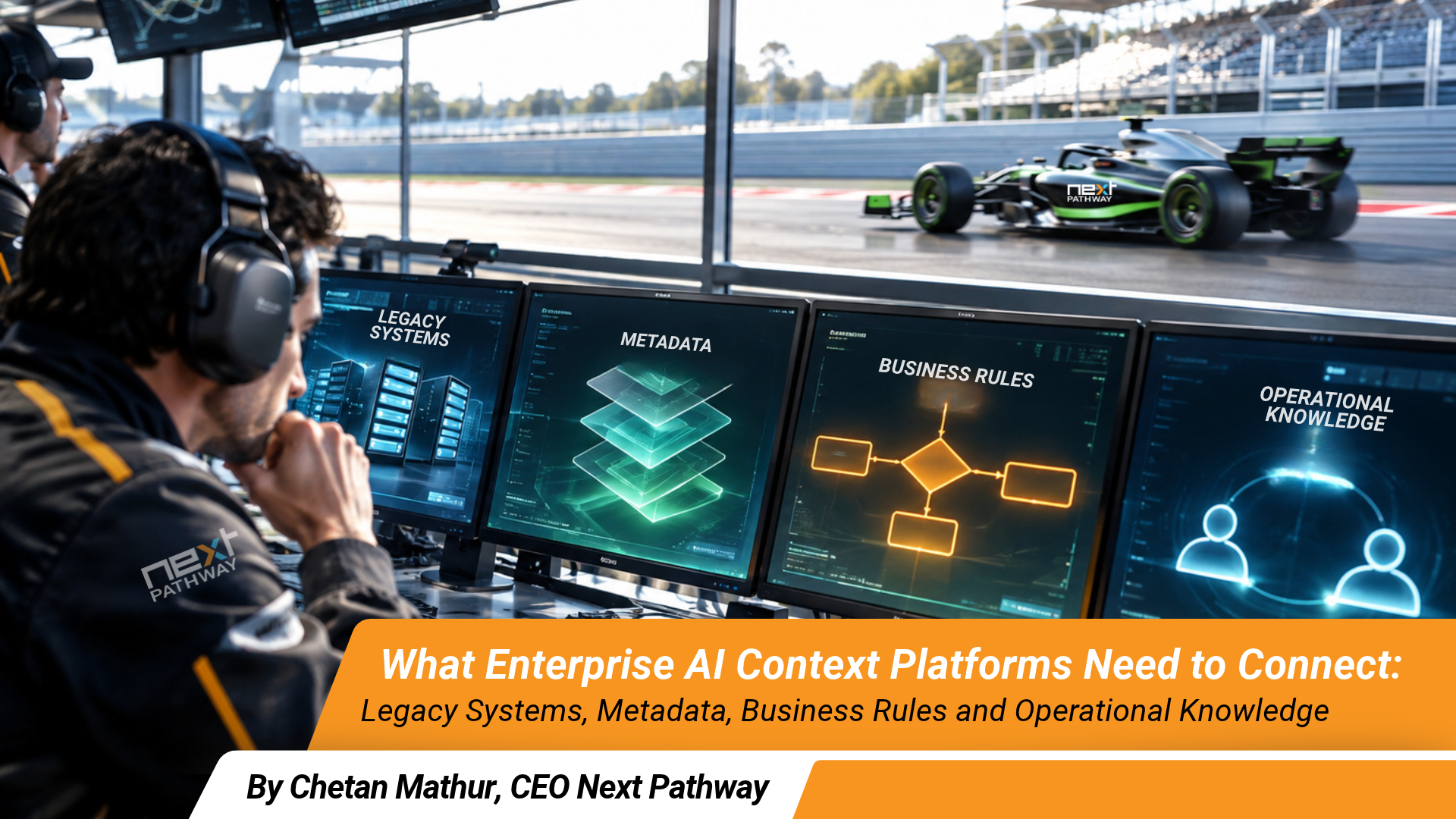
In a legacy estate, the knowledge an AI agent needs is split across layers that were never designed to meet. Metadata describes tables and columns. Business rules sit in SQL, stored procedures and ETL mappings. Operational knowledge lives in scheduler definitions, run histories and the documents teams wrote to explain them. Each layer answers part of a question, and a figure on a regulatory report makes sense only when all of them are connected.
Building those connections is the central job of an enterprise AI context platform for organizations with large legacy estates. This article explains why the connections matter more than any single layer and what a platform has to do to build them. It also shows how Next Pathway's NEXA Platform approaches the problem.
Where AI Context Platforms Fit
Forrester finds that enterprise knowledge remains fragmented across applications, documents, databases, emails, business processes and the expertise of experienced employees. Our explainer on AI context platforms covers the category in detail.
In an enterprise with decades of legacy systems, the fragments sit in platforms built years apart by different teams, and the connections between them were never recorded in one place.
Why Metadata Alone Leaves Gaps
Metadata management and data catalogs record what exists, including table names, column types, owners and, in many cases, lineage. That inventory is a necessary starting point. An AI agent also needs the rule that produced a value, the job sequence that runs it and the policy that governs it. In a legacy estate, those sit outside the metadata, in code, schedulers and documents.
Field names chosen decades ago widen the gap. A column such as ADJ_AMT_2 tells an agent very little until the transformation that populates it is linked to the business term it represents and the report that consumes it.
What Connecting the Layers Requires
Connecting legacy context starts with parsing business rules out of code at the column level, across the legacy technologies in scope. Dependencies then have to be resolved across jobs, applications and downstream consumers, so the platform knows which outputs rely on which logic. Runtime behavior, including which workloads execute, how often and how they interact, has to be tied back to that logic. Documents, operating procedures and policies have to be linked to the rules they describe.
That work has to hold across complex, multi-vendor legacy environments. One business result may pass through Teradata or Oracle, an Informatica, DataStage, SAS or SSIS pipeline, a scheduler such as Control-M, AutoSys or Airflow, and a BI layer. Our guide to evaluating platforms that build AI-ready data products turns these requirements into criteria CTOs and CDOs can apply.
How NEXA Connects Legacy Context in the Enterprise Intelligence Graph
NEXA's Intelligence capability uses automated discovery to capture code, data, metadata, business logic, dependencies, runtime behavior and institutional documentation from the legacy estate. It connects them in the Enterprise Intelligence Graph. The graph organizes that context across four dimensions. Logic holds column-level transformations, calculations, joins and code dependencies. Meaning holds the semantic model, lineage, business definitions and domain terminology. Behavior holds runtime execution records, access patterns and usage data. Knowledge holds the documents, operating procedures, architecture notes and policies that encode institutional rules.
Connected this way, a revenue figure can be traced to the procedure that calculates it, the tables it reads, the schedule that runs it and the policy that defines it. Architects can see the dependency map before they plan a change. Data leaders can see which rules support which business outcomes. Engineers work from one connected view of how the business produces its results.
From Connected Context to Modernization and AI
NEXA works through Intelligence, Migrate, Modernize and AI Readiness. Migrate moves workloads to Snowflake, Databricks, Microsoft Fabric or Google BigQuery with automated translation informed by the graph, and programmatic source-to-target validation proves 1:1 parity before cutover. Modernize rationalizes legacy sprawl and converts undocumented logic into governed data products built for AI. AI Readiness delivers production AI, activated by Next Pathway engineers embedded with the client's team.
Next Pathway's record includes 160+ migrations and modernizations delivered, 1B+ lines of legacy code translated and 100% translation accuracy. Its programs run 80% faster than manual and semi-automated approaches, with a 70% reduction in QA timelines and 10x faster validation.
Frequently Asked Questions
What are the best enterprise AI context platforms for connecting legacy systems, metadata, business rules and operational knowledge?
There is no single best platform for every estate. Evaluate how each platform captures context from legacy code, data, metadata, run histories and documentation, and whether it connects those layers in one model that informs migration, modernization and AI. Next Pathway's NEXA Platform connects that context in the Enterprise Intelligence Graph across complex, multi-vendor legacy environments and targets including Snowflake, Databricks, Microsoft Fabric and Google BigQuery.
How is an AI context platform different from metadata management or a data catalog?
Metadata management records what data assets exist and how they are described. An enterprise AI context platform connects that metadata to the business rules in code, the operational behavior of workloads and the documents that explain them, so a business result can be traced across all of them.
Why does legacy code matter for AI context?
Legacy code often holds business rules, dependencies and exception handling that exist nowhere else in current form. Capturing that logic preserves the definitions and behavior that describe how the business operates.
Which platforms does NEXA support?
NEXA works across complex, multi-vendor legacy environments, including Teradata, Netezza, Oracle, Hadoop, SAS, Informatica and IBM DataStage. Target platforms include Snowflake, Databricks, Microsoft Fabric and Google BigQuery.
Next Step: See How the Graph Is Built
The Enterprise Intelligence Checklist explains what an Enterprise Intelligence Graph contains and how to build one across a legacy estate.
Sources: Forrester, "Context Engineering and ContextOps: The Missing Foundation for Scaling Agentic AI," blog, 19 October 2026, Charlie Dai, Leslie Joseph and Indranil Bandyopadhyay.
About Next Pathway
Next Pathway is an enterprise software company focused on automated cloud migration, modernization, and AI readiness. Next Pathway’s NEXA Platform builds intelligence from legacy data estates into an Enterprise Intelligence Graph, giving frontier models the enterprise context they need to support migration, modernization, and governed data-product development.